







Free To Grow
Mailman School
of Public Health
Columbia University
722 West 168th Street,
8th Floor
New York, NY 10032
|
 |
 |
 |
  |
Hot Spots
Policing: Law Enforcement

|
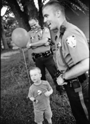
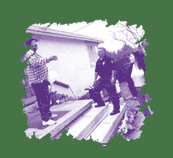
Hot Spots are areas in communities where heavy drug and criminal activity occur. Police are well aware of the existence of hot spots that generate a large number of calls for service from community residents and others. Nationally, it is estimated that 10 percent of locations generate 60 percent of crimes. The presence of uniformed officers at these locations can deter possible criminal activities and also offer a quick response to service calls. Hot spot strategies, such as concentrating law enforcement officials at a site for an extended period of time during the day, can disrupt retail drug sales without necessarily increasing arrests. Today, police departments can use computer technology, such as geographic information systems (GIS), to map drug and criminal activity. The use of GIS can help departments inform officers and investigators of crime incident locations, make resource allocation decisions, evaluate interventions, inform residents about crime activity and changes in their community and identify repeat calls-for-service.
(Adapted from Promising Strategies to Reduce Substance Abuse - An Office of Justice Programs Issues and Practices Report, September 2000, p. 58, U.S. Department of Justice,http://www.ojp.usdoj.gov/docs/psrsa.pdf and The Use of Computerized Crime Mapping by Law Enforcement, January 1999, p. 3, National Institute of Justice, http://www.ncjrs.org/pdffiles1/fs000237.pdf)
|
Evaluation
The more precisely patrol presence is concentrated at the "hot spots" and "hot times" of criminal activity, the less crime there will be in those places and times.
(Excerpted from A Report to the United States Congress, prepared for the National Institute of Justice, Preventing Crime: What Works, What Doesn't, What's Promising, Lawrence Sherman, et. al., Chapter 8 - Policing for Crime Prevention, 1998, http://www.ncjrs.org/works/chapter8.htm)
|
|
|